
Ruby on Rails development …
The Comprehensive Guide to Ruby on Rails Development
Introduction to Ruby on Rails Development
Ruby on Rails development is a popular framework for building web applications efficiently and effectively. It combines the Ruby programming language with Rails, a powerful framework that simplifies the process of creating robust web applications. This guide will delve into the intricacies of Ruby on Rails, providing insights into its core features, advantages, and best practices.
What is Ruby on Rails?
Ruby on Rails, often referred to as Rails, is an open-source web application framework written in the Ruby programming language. It follows the Model-View-Controller (MVC) architecture, which promotes organized and maintainable code. This architecture separates the application’s logic into three interconnected components: the model, the view, and the controller.
Key Features of Ruby on Rails
Ruby on Rails development boasts several key features that make it a preferred choice for developers:
- Convention over Configuration: Rails emphasizes convention over configuration, meaning developers can follow predefined conventions rather than writing extensive configuration files.
- DRY Principle: Rails promotes the “Don’t Repeat Yourself” (DRY) principle, reducing code duplication and enhancing maintainability.
- Scaffolding: Rails can generate scaffolding code for quickly creating prototypes.
- Active Record: This is the ORM (Object-Relational Mapping) layer in Rails, which simplifies database interactions.
- Routing System: Rails provides a robust routing system for mapping URLs to controllers and actions.
Benefits of Using Ruby on Rails
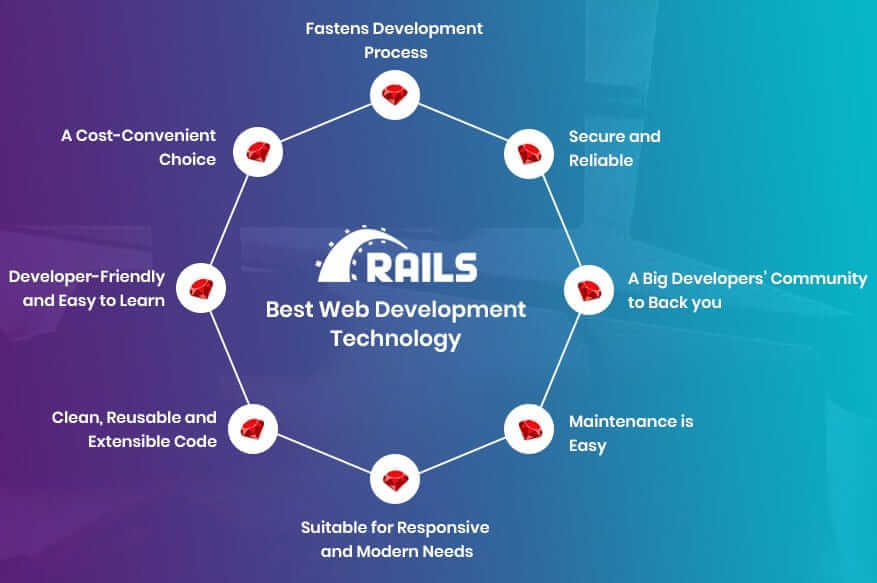
Ruby on Rails development offers numerous benefits, including:
- Rapid Development: Rails’ conventions and libraries enable rapid development and deployment of applications.
- Scalability: Rails applications are highly scalable, making them suitable for both small and large projects.
- Community Support: A large, active community continuously contributes to Rails, ensuring it remains up-to-date and secure.
- Rich Libraries: Rails has a vast collection of libraries (gems) that extend its functionality.
Setting Up a Ruby on Rails Development Environment
To get started with Ruby on Rails, follow these steps:
1. Install Ruby: Ensure Ruby is installed on your system. You can use a version manager like RVM or rbenv.
2. Install Rails: Use the gem package manager to install Rails (gem install rails).
3. Set Up a Database: Configure a database such as SQLite, PostgreSQL, or MySQL.
4. Create a New Rails Application: Generate a new Rails application using rails new app_name.
5. Run the Development Server: Start the server with rails server and visit http://localhost:3000 to see your application.
Core Components of a Ruby on Rails Application
A typical Ruby on Rails development project consists of several core components:
Models
Models represent the data and business logic of your application. They are responsible for interacting with the database and defining relationships between data entities.
Views
Views handle the presentation layer of your application. They render HTML templates and display data to the user.
Controllers
Controllers manage the flow of data between the models and views. They handle user requests, process data, and determine which views to render.
Best Practices in Ruby on Rails Development
To ensure your Ruby on Rails projects are successful, follow these best practices:
- Follow Conventions: Adhere to Rails conventions to maintain consistency and reduce configuration overhead.
- Write Tests: Implement unit tests, integration tests, and functional tests to ensure your application behaves as expected.
- Use Version Control: Employ version control systems like Git to manage your codebase effectively.
- Optimize Performance: Monitor and optimize your application’s performance using tools like New Relic and Skylight.
- Stay Updated: Keep your Rails application and gems up-to-date to benefit from the latest features and security patches.
Common Challenges in Ruby on Rails Development
Despite its many advantages, Ruby on Rails can present certain challenges:
- Learning Curve: Newcomers may find Rails’ conventions and architecture challenging to grasp initially.
- Performance Issues: Rails applications can encounter performance bottlenecks, especially with large datasets.
- Complex Configuration: Configuring Rails for production environments can be complex and requires careful attention to detail.
Advanced Topics in Ruby on Rails Development
For those looking to deepen their understanding of Ruby on Rails, exploring advanced topics is essential:
RESTful APIs
Rails supports the creation of RESTful APIs, enabling seamless communication between client and server applications.
WebSockets
Implementing WebSockets in Rails allows for real-time communication between clients and servers, enhancing user experience.
Background Jobs
Use background job frameworks like Sidekiq or Resque to handle time-consuming tasks asynchronously.
Security
Ensuring the security of your Rails application is paramount. Implement measures like secure password handling, CSRF protection, and input validation.
Conclusion
Ruby on Rails development offers a robust and efficient framework for building web applications. Its emphasis on convention, simplicity, and productivity has made it a favorite among developers worldwide. By understanding its core features, benefits, and best practices, you can harness the full potential of Ruby on Rails for your projects. Whether you are a beginner or an experienced developer, mastering Ruby on Rails will undoubtedly enhance your web development skills.